

Note: This article was originally published August 29, 2025.
Ben Konkin lived life to the fullest. Together with his wife Julia, he embraced adventure and thrived in the fast lane—both literally and figuratively. He had a love for driving fast cars and driving his cars at local speed tracks. Ben chased excitement wherever he could. The couple shared countless memorable experiences, from frequent trips to Disneyland to travels across Hawaii, Europe, and the desert.
But in 2017, everything began to change.
At just 36 years old, while out golfing with his dad Dann, Ben mentioned that something was feeling off with his wrist and showed Dann a white band he had wrapped around his wrist to help with the creeping pain he was experiencing.
“Ben thought maybe it was arthritis,” Dann remembers, “which was concerning, given how young Ben was at the time.”
He and Julia moved to Kelowna in 2017. Ben’s pain and discomfort only continued to grow. Initially misdiagnosed, Ben eventually learned he had systemic sclerosis, also known as scleroderma, a rare autoimmune disease that hardens the body’s connective tissues and organs.
Despite the setbacks the scleroderma presented, Ben fought back relentlessly. Through multiple hospital stays, his resolve never wavered—even when, in October 2018, he went into septic shock and nearly didn’t make it. With precision Dann can still recite a call from Julia seven years ago: “I remember the doctor taking the phone from Julia and saying, ‘Your son is in ICU; you’d better get here. Fast.’”
But Ben pulled through. Time and again, he amazed those around him with his resilience. By 2019, the disease was taking a visible toll. Once 6’3” and 250 pounds, Ben had been depleted to just 159 pounds.

After a period of relative stability, Ben’s health issues started to decline in the Fall of 2022. Ben was admitted to Vancouver General Hospital in early May 2023 following a cardiac event. Once stabilized, the family experienced another surge of hope: Ben was assessed for a double lung transplant and added to the transplant list. The family began to let themselves imagine a future where Ben could return to a somewhat normal life. The transplant would give some much-needed relief to his heart, which had been overworked for too long due to the damage the scleroderma had caused his lungs.
“This could change everything,” Dann recalls thinking.
After receiving his double-lung transplant in July 2023, despite small victories—a few hours off his ventilator, times of smiles and grins, and glimmers of old Ben— his new lungs and many of his vital organs began to shut down. An improved quality of life on the other side of transplant never materialized.
On November 21, 2023, Ben passed away.
“He was brave until the very end,” remembers Dann.
The Legacy of Research
Ben’s story of courage doesn’t end there.
In the months following Ben’s passing, Dann and the Foundation Board of the Founder’s Cup Charity Classic – a golf tournament that Dann has volunteered with for 25+ years – put forward the idea to donate to a charity in Ben’s name.
The Organ Donation and Transplant Research Foundation of BC (ODTRF) was chosen to receive the generous donation enabling Ben’s legacy to be one of hope and helping others fighting similar battles.
“Organ donation and transplantation occur every day, and the gift of receiving a donated organ, most times, can be life changing for the recipient,” says Dann. “Even in Ben’s case, with his declining health, it brought him, Julia and our families, hope that he may have a chance to extend his life and have a better quality of life from this transplant.”
“Once Ben was on the transplant list, we saw everything differently,” Dann says. “You realize that transplant isn’t just a medical procedure—it’s a second chance. But that second chance also means someone else has lost a loved one. It’s the hardest, most generous gift anyone can give.”
ODTRF funds the innovative work of B.C. scientists and clinicians, who are working to increase the number and quality of organs available for transplantation as well as extend and improve the lives of transplant recipients.
 “Had it been possible, Ben would have donated any organ he could; it was in his nature to give,” Dann reflects. “Our family’s hope is that our support can help fuel research that improves patient outcomes, through better methods for organ preservation and better matching techniques for donors and recipients. As well as improved drug therapy to assist in reducing rejection rates and ultimately, enhance the quality of life for patients. We also see an enormous benefit in raising awareness about the importance of organ donation and encouraging more individuals to register as donors.”
Now, through the work of the ODTRF and the $5,000 donation, Ben’s legacy will continue to give—funding research that will help save lives and change the transplant story for future patients.
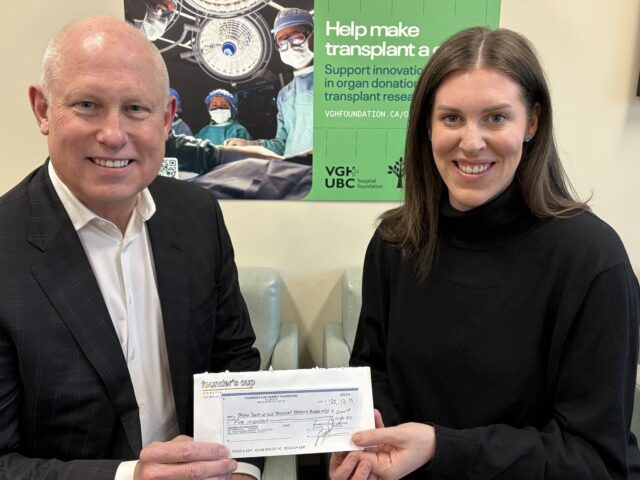
Update (2026): Since this story was first shared, Ben’s legacy has continued through the generosity of his family. In memory of Ben, they recently donated another $5,000 to the Organ Donation and Transplant Research Foundation of BC through the Founder’s Cup Golf Tournament, supporting research that makes a difference for patients. This brings the total amount donated to $10,000 that will help fund vital organ donation and transplant research, ensuring more transplant recipients have the chance not just to receive a transplant—but to truly experience its life-changing impact.