

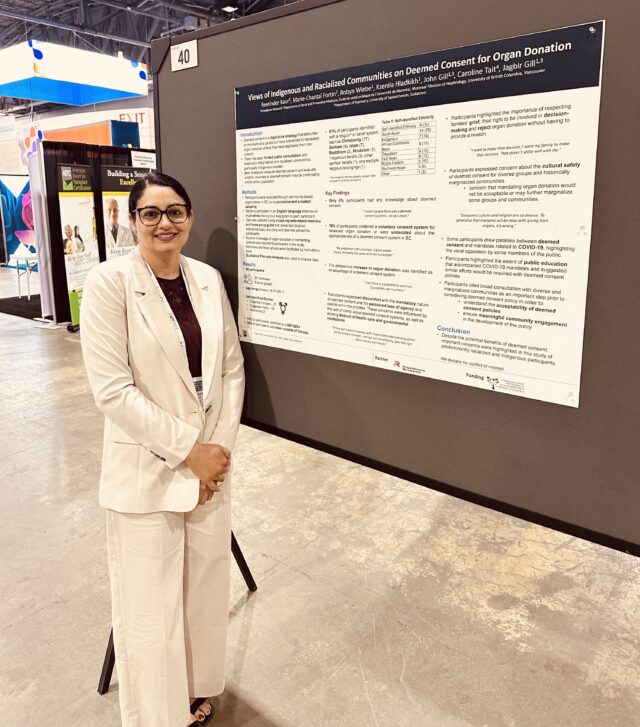
To celebrate International Day of Women and Girls in Science, we had the opportunity to hear from researcher Reetinder Kaur about her path into science—one shaped by curiosity, determination, and a strong commitment to equity. After beginning her academic journey in India and later moving to Canada, her work came to focus on the relationship between health and social science. Her work in organ donation and kidney transplant research quickly became a passion, particularly as she began examining racial and gender inequities in access.
Today, Reetinder helps lead innovative qualitative research on inequity in living kidney donation, including a recent ODTRF funded project in conjunction with senior scientist Dr. Jagbir Gill entitled, A unique reciprocity-based strategy to improve living kidney donations in British Columbia: Focus Group Consultations. Their efforts are helping advance Donate Now, a new reciprocity-based policy proposal designed to removed barriers and transform living kidney donation in British Columbia.
Q: What inspired you to pursue a career in science, particularly related to organ donation and transplantation?
A: Growing up in India, science was a culturally encouraged pathway, that is where my academic journey began. However, it was during my undergraduate studies in Anthropology that my perspective truly shifted. I noticed how few women were visible as educators and researchers in the field, and this realization motivated me to continue my education and carve out space for myself within the discipline.
When I moved to Canada in late 2019, I began working at the intersection of health and social science—a space I find incredibly exciting and one where South Asian women remain underrepresented. As for organ donation and kidney transplantation research, I often say that the field chose me. It was my first full-time role as a new immigrant in Canada. As I immersed myself in this work, I became deeply fascinated by its complexities, particularly issues of racial and gender inequity in access to kidney transplant. This continues to inspire and drive my research today.
Q: What excites you most about your current research?
A: I am currently leading qualitative research on gender inequity in living kidney donation. This is a relatively new area with significant potential for growth and future research. I am especially excited about how I chose my PhD topic. It was a journey that unfolded as I worked on multiple projects, learned through experience, and engaged closely with the organ donation and kidney transplant community. This journey was strongly shaped by my PhD supervisors, Dr. Jagbir Gill and Dr. Fuchsia Howard, and our patient partners.
Q: For young women considering a career in science, what words of advice do you have?
A: My advice to young women considering a career in science is to seek a mentor early on—someone who can genuinely support, encourage, and guide you along your journey. A strong mentor can help you navigate career options, build confidence and open doors to opportunities you may not have otherwise considered.
Q: How has mentorship shaped your career, and who has most influenced you along the way?
A: Mentorship has been pivotal in shaping my career, particularly as I had to restart my professional journey after immigrating to Canada. I was fortunate to work with Dr. Jagbir Gill, a well-established and highly respected researcher in organ donation and kidney transplant research. Through his guidance and support, I gained access to opportunities that may not have otherwise been available to me as an immigrant.
I had the privilege of working with him on several research projects and presenting our work at conferences across Canada and the United States. These experiences strengthened my research skills and helped me build meaningful professional networks nationwide. This journey ultimately contributed to me receiving the nationally prestigious KRESCENT Doctoral Fellowship from the Kidney Foundation of Canada for my PhD research focused on gender inequity in living kidney donation.
Reetinder’s impact is reflected in the recognition and accolades she has earned. She is a powerful role model for girls in science, and we are proud to have supported her important and inspiring work.
Donate Today!